

How Vegas Room Rates Are Set: a 2026 Guide
Disclosure: This post may contain affiliate links. We may earn a commission for purchases made through links in this post, at no cost to you.
Las Vegas hotel pricing is controlled by automated revenue management systems (RMS) that adjust room rates dynamically, sometimes multiple times per day, based on real-time demand, competitor moves, and market signals. Understanding how Vegas room rates are set gives you a jaw-dropping advantage before you ever hit “book.” The number on your screen is not a fixed price. It is a living, breathing output from algorithms that never sleep, and knowing what drives it can save you serious money on your next trip to the Strip.
What factors influence Las Vegas hotel room rates?
The single biggest driver of Las Vegas hotel pricing is demand relative to forecasted occupancy. Booking pace is the leading signal: when reservations come in faster than expected, prices climb. When they lag, rates drop to stimulate bookings. This is not guesswork. It is math running at machine speed.

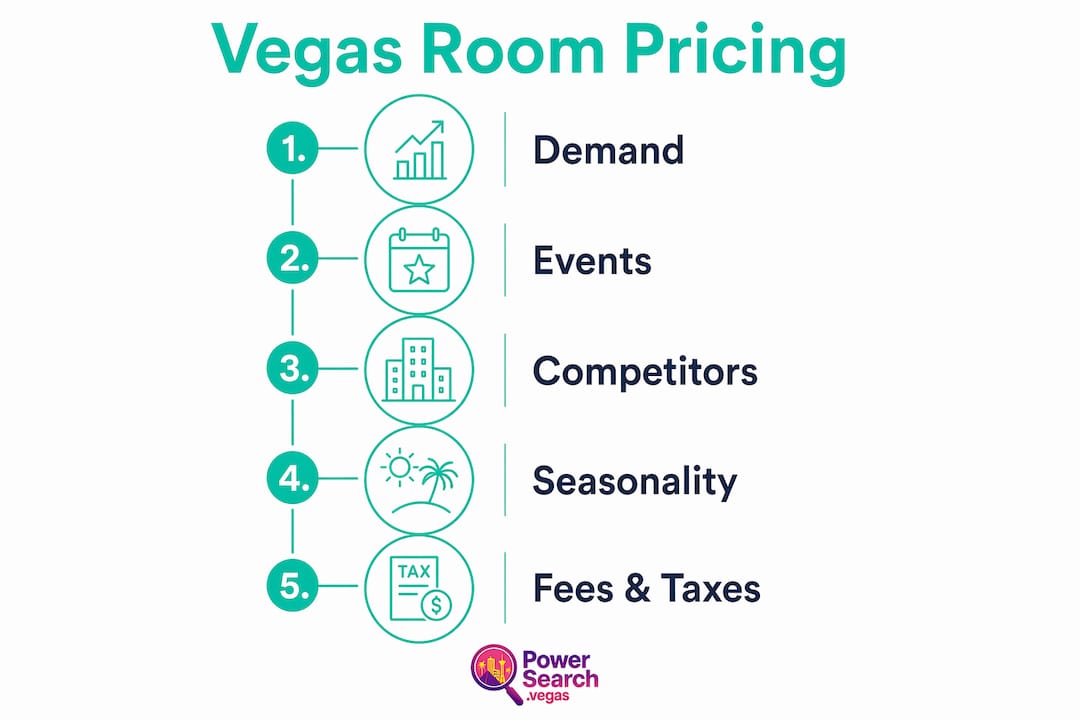
Several forces shape that demand curve on any given night:
Conventions and events create the most dramatic spikes. When the Consumer Electronics Show, the NFL Draft, or a major boxing match lands in Las Vegas, hotels across the Strip and downtown respond within hours. Event-driven pricing is one of the most powerful forces in the market, and it can double or triple a base rate overnight.
Weekday versus weekend patterns are baked into every hotel’s pricing model. Friday and Saturday nights consistently command premium rates because leisure travelers flood the city. Sunday through Thursday rates are often 30 to 50 percent lower on the same property, which is a pattern worth knowing if your travel dates are flexible.
Competitor pricing creates constant market pressure. Hotels monitor each other’s rates in real time, and an RMS will automatically respond when a nearby competitor drops or raises its price. The Strip operates like a living pricing ecosystem where no major property sets rates in a vacuum.
Seasonality adds another layer. Spring and fall bring peak convention traffic. Summer draws families but also extreme heat, which softens demand slightly. December holidays spike rates again. Strip hotels averaged $205 per night in April 2026, while downtown rates declined, showing that even within the same city, pricing strategies diverge sharply by location.
Pro Tip: Check rates for the same room on a Tuesday versus a Friday before you commit to travel dates. The difference can be staggering, and shifting your arrival by one day sometimes unlocks a dramatically lower rate.
How do dynamic pricing and revenue management systems work?
Revenue management systems are the invisible engine behind every rate you see on a Vegas booking platform. These systems process hundreds of room and date combinations simultaneously, applying algorithms that weigh historical data, current inventory, cancellation patterns, and competitor rates to produce an optimal price at any given moment.
The speed is mind-bending. Modern RMS platforms can update rates one to three times daily, with some systems claiming up to 150 million daily calculations. A room that costs $89 at 9 a.m. can legitimately hit $225 by 3 p.m. if a wave of bookings comes in. No human made that call. The algorithm did.
Here is how the core mechanics work:
-
Rate tiers open and close automatically. The same room on the same date may carry five or six different price levels. Rate tiers open when inventory is plentiful and close as rooms sell, which is why two guests booking the same room a week apart can pay wildly different prices.
-
Booking velocity triggers real-time adjustments. Booking velocity is the rate at which rooms are reserved. Slower-than-forecast velocity causes prices to drop. Faster-than-forecast velocity pushes prices up. This is the core feedback loop of dynamic pricing.
-
Revenue managers set guardrails. Humans still define minimum and maximum rates and control how large each price step can be. The algorithm operates within those boundaries, balancing occupancy goals against revenue targets throughout the booking window.
-
Cancellation data feeds back into the system. When cancellations spike, the RMS treats that as a demand signal and may lower rates to refill inventory quickly. When cancellations are low and rooms are holding, prices stay firm or rise.
“Dynamic pricing, multiple rate tiers, and inventory segmentation ensure prices can vary widely even day to day. The traveler misconception that hotel room prices are static is simply false.”
How do resort fees and taxes impact the final Vegas room cost?
Resort fees are the single most misunderstood element of Las Vegas hotel pricing, and they hit harder than most travelers expect. Vegas Strip resort fees in 2026 range from $45 to $55 per night before tax, covering amenities like Wi-Fi, pool access, and fitness centers. Clark County’s lodging tax of 13.38% then applies on top, pushing a $50 resort fee to roughly $56.69 per night after tax.
The real trap is the displayed rate. Displayed room rates often exclude resort fees, so a $200 room that looks like a deal can become $262.36 per night once you add a $55 resort fee and the applicable tax. That gap between the advertised price and the total cost is where most travelers get surprised at checkout.
| Scenario | Base Rate | Resort Fee (pre-tax) | Total After 13.38% Tax on Fee |
|---|---|---|---|
| Budget Strip room | $89/night | $45/night | $140.02/night |
| Mid-range Strip room | $150/night | $50/night | $206.69/night |
| Premium Strip room | $200/night | $55/night | $262.19/night |
Some hotels are moving toward all-inclusive bundle pricing that folds resort fees into the headline rate, with packages ranging from $104 to $400 per night. These bundles eliminate the sticker-shock problem and make comparison shopping far more straightforward. Not every property offers them, but they are worth seeking out if fee transparency matters to you.
Pro Tip: Always multiply the resort fee by your number of nights, add 13.38% tax, then add that total to the base room cost before comparing properties. Two hotels with identical room rates can have a $100 difference in total trip cost based on fee structures alone.
How do events and booking timing affect Vegas hotel pricing?
Event-driven pricing in Las Vegas follows a counterintuitive pattern that catches many travelers off guard. Early prices may start low to fill rooms before an event, then spike sharply in the final days as demand peaks and travelers become less price-sensitive. During Super Bowl weekend 2026, Strip rooms were available under $100 early in the booking window, with average two-night stays settling around $138.88. Those same rooms climbed significantly as the event approached.
This pricing pattern reflects a deliberate revenue strategy built around traveler psychology:
Early in the booking window, hotels prioritize occupancy over rate. They price rooms attractively to lock in reservations and generate cash flow. As the event date nears and remaining inventory shrinks, the algorithm recognizes that late-booking travelers are committed and willing to pay more. Rates jump accordingly.
Weekday versus weekend timing adds another dimension. A room booked for a Wednesday night during a slow convention week behaves very differently from the same room on a Saturday during a sold-out fight weekend. Understanding these room rate fluctuations by day and event type is one of the most practical skills a Vegas traveler can develop.
Last-minute bookings can go either way. If a hotel is running below forecast occupancy three days out, the RMS will drop rates aggressively to fill rooms. If the city is sold out for a major event, last-minute rates will be eye-watering. The key variable is whether demand is outpacing supply or lagging behind it.
What booking strategies can travelers use to navigate Vegas room rates?
Knowing how hotel rates are determined is only half the battle. Translating that knowledge into smarter bookings is where the real payoff lives. Here are the strategies that actually move the needle:
Compare total cost, not just room rate. Always factor resort fees and taxes into your comparison. A $120 room with a $55 resort fee costs more per night than a $155 room with no resort fee. The downtown versus Strip pricing gap is a perfect example: downtown hotels often have lower base rates and lower resort fees, making the total cost difference even larger than the headline rate suggests.
Book early for major events, not late. For Super Bowl weekends, New Year’s Eve, and major convention dates, the early-booking window offers the best rates. Waiting until two weeks out means paying peak prices for shrinking inventory.
Use hotel loyalty programs strategically. Members of programs like Caesars Rewards or MGM Rewards often receive resort fee waivers or discounted rates not available on third-party platforms. These waivers can save $50 to $60 per night, which adds up fast on a multi-night stay.
Check multiple booking platforms. Distribution channel differences mean the same room can show different prices on different sites, with some including fees and others excluding them. Booking directly with the hotel sometimes unlocks rates or perks that aggregator sites cannot match.
Consider all-inclusive bundles for budget clarity. If you want zero surprises at checkout, look for properties offering bundled packages that fold resort fees into the nightly rate. The budget hotel options in Las Vegas increasingly offer these structures to attract cost-conscious travelers.
Pro Tip: Set a rate alert on your target hotel for your travel dates. If the hotel is running below forecast occupancy, the RMS will drop prices, and you can rebook at the lower rate if the property allows free cancellation.
Key takeaways
Vegas room rates are set by automated revenue management systems that adjust prices multiple times daily based on booking velocity, event demand, competitor rates, and inventory levels, making timing and total-cost awareness the two most powerful tools a traveler has.
| Point | Details |
|---|---|
| Dynamic pricing is automated | RMS platforms update rates up to three times daily, sometimes shifting prices by $100 or more within hours. |
| Resort fees change the real cost | Strip fees of $45 to $55 per night plus 13.38% tax can add over $60 per night to your displayed room rate. |
| Events drive the biggest spikes | Book early for major events; prices climb sharply in the final days as inventory tightens and demand peaks. |
| Booking velocity controls rates | Rooms fill faster than forecast? Prices rise. Bookings lag? Rates drop to stimulate demand. |
| Total cost comparison wins | Always add resort fees and tax to the base rate before comparing properties or platforms. |
Why most travelers are playing Vegas pricing on hard mode
I have spent years watching travelers walk into Vegas hotel pricing completely blind, and the pattern is always the same. They see a $99 room rate, feel like they scored, and then get hit with a $262 total at checkout. The frustration is real, and it is entirely avoidable.
The part that most articles skip is this: the RMS is not trying to trick you. It is doing exactly what it is designed to do, which is match price to demand at every moment in the booking cycle. When you understand that logic, you stop fighting the system and start working with it. Book early for events. Book late for slow weeks. Always check the total cost including fees. These are not hacks. They are just the natural consequences of understanding how the pricing engine actually works.
The resort fee issue genuinely bothers me, not because the fees are unreasonable, but because the lack of transparency in how they are displayed creates a false comparison environment. When one platform shows fees and another hides them, you cannot make an apples-to-apples decision. That is the real problem travelers face, and it is why knowing the math before you search matters more than any discount code.
— Mark
Find your best Vegas rate before you book

Powersearch takes the guesswork out of Vegas hotel pricing by surfacing real costs, not just the teaser rates. When you search on Powersearch.vegas, you get a clear view of what you are actually paying, including the resort fees and taxes that other platforms bury in the fine print. Whether you are chasing a budget-friendly weeknight deal or planning around a major event weekend, Powersearch helps you compare properties on a level playing field. Stop doing the resort fee math by hand and let the platform do the heavy lifting so you can focus on the part that actually matters: having an incredible time in Las Vegas.
FAQ
How often do Vegas hotel room rates change?
Vegas hotel room rates can change one to three times per day, with some automated systems processing up to 150 million daily calculations. Prices shift in response to booking velocity, competitor moves, and real-time inventory levels.
What are resort fees and how much are they in 2026?
Resort fees are mandatory nightly charges covering amenities like Wi-Fi and pool access. Strip resort fees in 2026 range from $45 to $55 per night before tax, with Clark County’s 13.38% lodging tax pushing the after-tax total to roughly $51 to $62 per night.
Is it cheaper to book Vegas hotels early or last minute?
For major events, booking early is almost always cheaper since prices spike sharply as the event date approaches. For non-event periods, last-minute bookings can yield lower rates if the hotel is running below its occupancy forecast.
Why does the same Vegas room cost different amounts on different sites?
Distribution channel differences mean some platforms display rates including resort fees while others show only the base room rate. Booking directly with the hotel sometimes unlocks member rates or fee waivers not available through third-party aggregators.
Do downtown Vegas hotels have lower resort fees than Strip hotels?
Downtown Las Vegas hotels generally have lower base rates and lower resort fees than Strip properties, making the total cost gap larger than the headline rate difference alone suggests. This makes downtown a strong option for budget-focused travelers.
No Comments