

Las Vegas Hotel Star Ratings Explained for Travelers
Disclosure: This post may contain affiliate links. We may earn a commission for purchases made through links in this post, at no cost to you.
You are staring at a Las Vegas hotel listing showing four stars, and the price tag makes your jaw drop. But is that rating actually telling you what you think it is? Las Vegas hotel star ratings explained in plain terms can save you from booking regret and help you find the stay that genuinely matches your trip. The truth is, star ratings in the U.S. are not standardized the way most travelers assume, and in a market as wild and dazzling as Vegas, that gap between expectation and reality hits harder than anywhere else.
Table of Contents
- Key takeaways
- Las Vegas hotel star ratings explained: who assigns them
- What each star level actually looks like in Vegas
- What star ratings cannot tell you about your stay
- How to use star ratings when booking your Vegas trip
- My honest take on Vegas star ratings
- Find your perfect Vegas hotel with Powersearch
- FAQ
Key takeaways
| Point | Details |
|---|---|
| No universal rating system | U.S. hotel stars come from multiple sources with different standards, so two hotels can show the same rating for different reasons. |
| Stars measure inputs, not experience | Ratings reflect amenities and features, not how good your actual stay will feel. |
| 4-star hotels offer serious value | Vegas 4-star properties deliver resort-level amenities at roughly 30% less than comparable 5-star hotels. |
| Unofficial ratings are marketing | Terms like “6-star” or “7-star” are not recognized by any official body and exist purely for promotion. |
| Reviews complete the picture | Pair star ratings with recent guest reviews to get an accurate read on service, cleanliness, and atmosphere. |
Las Vegas hotel star ratings explained: who assigns them
Before you trust a star rating, you need to know who put it there. In the U.S., hotel stars are not government-regulated, which means there is no single authority handing out ratings the way a health department grades a restaurant. Different organizations use completely different methods, and that creates real inconsistency across platforms.
Here is how the main rating sources break down:
Booking platforms and algorithms. Sites like Expedia or Hotels.com often assign stars based on self-reported data from the hotels themselves, combined with algorithmic scoring. A hotel fills out a form about its amenities, and the platform assigns a number. There is no inspector walking the halls.
Professional inspection organizations. Forbes Travel Guide is the gold standard in North America. Their inspectors use up to 900 objective standards and visit properties anonymously. Earning a Forbes five-star distinction is genuinely rare and prestigious. When you see that badge, it carries weight.
AAA Diamond Ratings. AAA sends trained evaluators to inspect properties and assigns one to five diamonds. Their criteria lean heavily on cleanliness, service, and physical condition. It is a respected system, though separate from Forbes entirely.
Self-reported and marketing stars. Some hotels simply declare their own star level in their branding. No verification required. This is where things get murky for travelers researching Las Vegas accommodation ratings.
The practical takeaway here is that the same hotel might show as three stars on one booking site and four stars on another. That is not a glitch. It is a direct result of how fragmented the hotel star rating system really is.
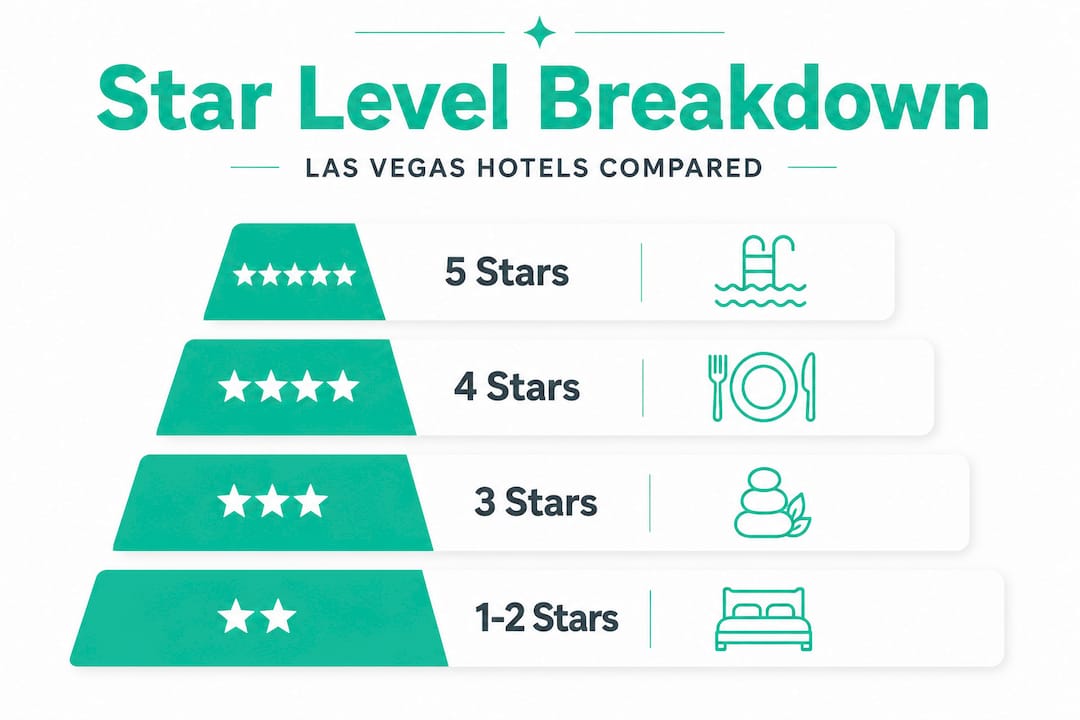
What each star level actually looks like in Vegas
Understanding hotel star ratings gets a lot more interesting when you zoom into the Las Vegas market specifically. Vegas hotels do not operate like hotels in other cities. The scale, the spectacle, and the sheer density of options on the Strip mean that each star level carries its own distinct flavor.
| Star Level | Typical Features | Best For |
|---|---|---|
| 1 to 2 stars | Basic rooms, limited amenities, off-Strip locations | Budget travelers, short stays |
| 3 stars | Comfortable rooms, pool, basic dining, some resort perks | Casual visitors, value seekers |
| 4 stars | Multiple pools, full-service spa, diverse dining, fitness center | Most travelers wanting resort experience |
| 5 stars | Private check-in, concierge floors, exclusive pools, luxury finishes | Luxury seekers, special occasions |
One and two-star hotels in Vegas keep things simple. You get a clean bed, basic Wi-Fi, and a location that probably requires a cab or rideshare to reach the Strip. They serve a purpose, especially for travelers who plan to spend most of their time out exploring rather than lounging at the hotel.
Three-star hotels step it up with a pool, a restaurant or two, and rooms that feel genuinely comfortable. You are not roughing it. Many three-star properties near the Strip offer solid value and a pleasant stay without the resort fees that pile up at higher-tier properties.

Four-star hotels are where Vegas really starts to dazzle. Think multiple pools, full-service spas, a lineup of dining options from casual to upscale, and fitness centers that rival standalone gyms. 4-star hotels on the Strip deliver resort infrastructure at rates about 30% lower than comparable five-star properties on the same block. That is a meaningful difference when you are booking for several nights.
Five-star hotels add a layer of exclusivity that four-star properties simply do not match. We are talking private check-in, dedicated concierge floors, and exclusive pools that keep the crowds away. The rooms themselves may not be dramatically different from a top-tier four-star room, but the experience around them is curated at a level that justifies the price for the right traveler.
Pro Tip: If you are traveling for a milestone birthday or anniversary and want the luxury feel without the full five-star price tag, look at suite offerings at four-star Strip hotels. Many offer suites with Strip views and kitchenettes that rival what you would get at a five-star property for significantly less money.
What star ratings cannot tell you about your stay
Here is where a lot of travelers get burned. Star ratings measure what a hotel has, not what staying there actually feels like. Stars are a shorthand for features, and the lived experience can differ significantly from what those features suggest on paper.
Think about it this way. A four-star hotel can have a gorgeous pool deck and a rooftop bar, but if the rooms on floors three through ten face a noisy loading dock, your sleep is going to suffer. Stars do not capture that. They do not measure noise levels, how responsive the front desk staff is at 2 a.m., or whether the air conditioning actually works in July.
“Star ratings serve as filters for amenities and service level, but travelers should rely on guest reviews to gauge the quality of the stay experience.” — What Hotel Stars Mean
A few specific things star ratings will not tell you:
Room-to-room quality variation. In large Vegas resort hotels, rooms on different floors or in different towers can vary wildly in quality, view, and noise level. Stars rate the property, not your specific room.
Cleanliness and maintenance. A hotel can have every amenity on the checklist and still have rooms that feel dated or poorly maintained. Recent guest reviews on platforms like TripAdvisor or Google catch this far better than any star rating.
Atmosphere and vibe. Some boutique hotels in Vegas carry a lower star count simply because they have fewer amenities, but they deliver a more personalized, memorable experience than a massive resort. Stars do not measure soul.
Unofficial star inflation. Watch out for marketing language. Terms like “6-star” or “7-star” are not officially recognized by any rating body. When a hotel calls itself seven-star, that is pure branding. There is no inspection behind it.
The smart move is to treat stars as your first filter, not your final answer. They narrow the field. Guest reviews close the deal.
How to use star ratings when booking your Vegas trip
Now that you know what stars mean and where they fall short, here is how to actually use Las Vegas hotel ratings to book with confidence.
Start with your trip purpose. Are you in Vegas for a concert weekend where you will barely be in the room? A three-star property near the venue makes perfect sense. Planning a honeymoon or a milestone celebration? Four or five stars is worth the investment. Matching the star level to your actual priorities saves money and prevents disappointment.
Lean into four-star properties for the best balance. Well-reviewed four-star hotels in Las Vegas can deliver about 90% of the luxury experience at roughly 30% less than five-star hotels. That gap is real money, especially over a multi-night stay. You still get the resort pools, the dining variety, and the Strip energy.
Time your booking around the Vegas calendar. Midweek stays and low convention periods offer the best rates in the four-star tier. Late January, early February, and mid-November tend to be sweet spots. New Year’s Eve and major event weekends spike prices across every star level, so book early or budget accordingly.
Factor in location alongside star level. A five-star hotel a mile off the Strip may feel less exciting than a four-star property right in the middle of the action. Walkability to shows, restaurants, and casinos matters enormously in Vegas. Check the map before you check the star count.
Read reviews from the last 90 days. Staffing, renovations, and management changes happen fast in Vegas. A hotel that was stellar two years ago might be mid-renovation right now. Fresh reviews give you the ground truth that stars never will.
Pro Tip: Filter your search by both star rating and guest review score together. A four-star hotel with a 9.0 guest score is almost always a better pick than a five-star hotel with a 7.5 score.
My honest take on Vegas star ratings
I have spent years helping travelers decode Las Vegas accommodation ratings, and the pattern I see most often is this: first-time Vegas visitors over-index on stars and under-index on reviews. They assume five stars guarantees a jaw-dropping experience, and sometimes it does. But I have seen four-star stays that outperformed five-star bookings on nearly every dimension that actually mattered to the traveler.
The exclusivity factor at five-star properties is real. Private check-in and dedicated concierge service genuinely hit different when you want to feel like a VIP. But if your priority is a great pool, solid dining, and a comfortable room in a prime location, a top-rated four-star property on the Strip often delivers more satisfaction per dollar than its pricier neighbor.
My advice? Use stars to filter out properties that do not meet your minimum requirements. Then let recent guest reviews tell you which ones actually deliver. The traveler who books a four-star hotel with 500 glowing recent reviews is almost always happier than the one who chased a five-star label and ignored the warning signs in the comments.
Focus on what your specific trip needs. Vegas is the real show. Your hotel is where you sleep, recharge, and maybe soak in a pool. Get the right fit for your trip, not just the most impressive number.
— Mark
Find your perfect Vegas hotel with Powersearch
Ready to put all of this knowledge to work? Powersearch is built specifically for travelers who want to cut through the noise and find Las Vegas hotels that match their star rating preferences, budget, and must-have amenities.

Whether you are hunting for a jaw-dropping five-star suite on the Strip or a well-reviewed four-star property that gives you resort vibes without the resort price, Powersearch lets you filter by star rating, location, price range, and guest score all in one place. No more bouncing between a dozen tabs trying to compare options. The platform pulls together detailed listings, amenity breakdowns, and pricing so you can make a confident booking decision fast. Your next Vegas adventure starts with the right room. Let Powersearch help you find it.
FAQ
What do hotel stars mean in Las Vegas?
Hotel stars in Las Vegas indicate the level of amenities, services, and facilities a property offers, ranging from basic accommodations at one to two stars up to ultra-luxury exclusivity at five stars. They do not measure the actual guest experience, so pairing star ratings with recent reviews gives you the most accurate picture.
Who assigns hotel star ratings in the U.S.?
There is no single government body that assigns hotel star ratings in the U.S. Ratings come from organizations like Forbes Travel Guide, AAA, and booking platform algorithms, each using different criteria and standards.
Are 4-star hotels in Las Vegas worth it?
Absolutely. Four-star hotels on the Strip offer resort-level amenities including pools, spas, and multiple dining options at roughly 30% less than five-star properties, making them the best value tier for most travelers.
What does a 5-star hotel offer that a 4-star does not?
Five-star hotels in Las Vegas typically add exclusivity features like private check-in, dedicated concierge floors, and exclusive pools not available to general guests. The core room quality is often comparable to top four-star properties.
Are “6-star” or “7-star” hotel ratings real?
No. Six-star and seven-star hotel ratings are unofficial marketing terms with no recognized rating body behind them. Any hotel using these labels is using them purely for promotional purposes.
No Comments