

Why Downtown Las Vegas Is Cheaper: a 2026 Guide
Disclosure: This post may contain affiliate links. We may earn a commission for purchases made through links in this post, at no cost to you.
If you’ve ever wondered why downtown Las Vegas is cheaper than the Strip, you’re not alone. Most travelers assume Vegas pricing is basically the same across the board until they check out and realize they left hundreds of dollars on the table. Downtown, centered around the legendary Fremont Street corridor, operates on a fundamentally different economic model. Hotel rates run nearly half the price of Strip properties, gambling minimums are lower, and the entertainment can be jaw-dropping without costing a cent. This guide breaks down exactly why the price gap exists and how you can use it to your full advantage.
Table of Contents
- Key takeaways
- Why downtown Las Vegas is cheaper: the real price breakdown
- Gambling economics downtown
- Walkability and its surprisingly high dollar value
- Trade-offs worth knowing before you book
- How to make the most of a downtown trip on a budget
- My honest take on downtown versus the Strip
- Find your perfect downtown deal with Powersearch
- FAQ
Key takeaways
| Point | Details |
|---|---|
| Hotels cost nearly half as much | Downtown hotel rates average around $97 per night versus $196 on the Strip in 2025. |
| Hidden fees hit harder on the Strip | Resort fees of $40 to $50+ and paid parking add significantly to Strip hotel totals. |
| Gambling stretches further downtown | Table minimums of $5 to $10 downtown give you more playing time per dollar than Strip floors. |
| Free entertainment is everywhere | The Fremont Street Experience delivers free live shows year-round, cutting daily entertainment costs dramatically. |
| Walkability saves real money | Downtown’s compact layout means fewer rideshares and less transit spend across your whole trip. |
Why downtown Las Vegas is cheaper: the real price breakdown
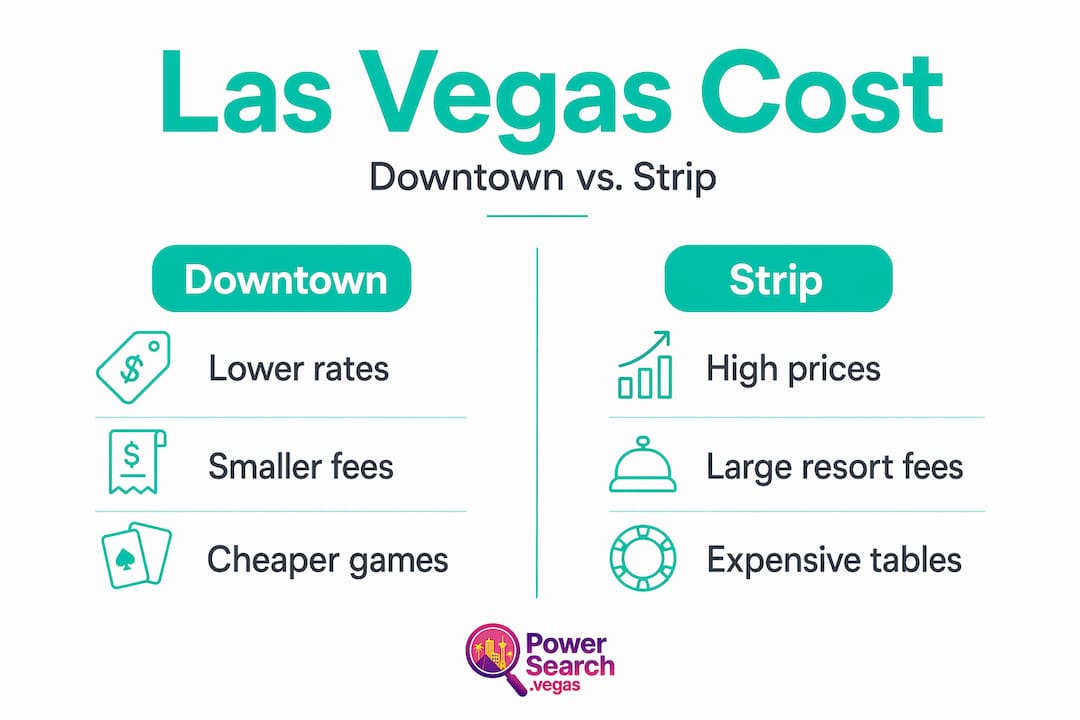
The numbers tell a clear story. Downtown hotel rates averaged $97.98 per night in 2025 compared to $196.54 on the Strip. That’s roughly double the price for a Strip address, and it gets steeper once you factor in what isn’t included in that headline rate.
Resort fees are where budget travelers get blindsided. Strip properties routinely charge $40 to $50+ in daily resort fees, stacked on top of your room rate at checkout. Many downtown hotels either charge smaller fees or skip them entirely. Parking compounds the gap further. Self-parking on the Strip can run $15 to $20 per day at properties that used to offer it free. Downtown, you’ll find surface lots, garages, and even free overnight parking attached to several casino hotels.
Here’s a quick comparison that puts it all in perspective:
| Cost component | Downtown Las Vegas | Las Vegas Strip |
|---|---|---|
| Average nightly room rate | ~$98 | ~$196 |
| Daily resort fee | $0 to $15 | $35 to $55 |
| Self-parking per day | Free to $10 | $15 to $25 |
| Estimated true daily cost | ~$100 to $115 | ~$240 to $275 |
The concept of true cost of stay is something seasoned Vegas travelers understand well. Strip hotels have spent the last decade monetizing every inch of their properties, from resort fees to poolside cabana rentals. When you check the review for a $150 Strip room rate and realize the final bill is closer to $220 after fees and parking, downtown’s $100 all-in night suddenly looks like a revelation.
Gambling economics downtown
This is where the budget math gets genuinely exciting. Downtown casinos offer table minimums of $5 to $10, while Strip floors typically start at $15 to $25 per hand or roll. That difference might sound small, but across a three-night trip it shapes your entire experience.
Think about it this way. If you’re playing blackjack at a $10 minimum for two hours, your hourly exposure is a fraction of what it would be at a $25 table on the Strip. Lower minimum bets downtown give you more control over how fast your bankroll moves, which is the single biggest factor separating a fun gambling experience from a stressful one. You get more time at the table, more entertainment value per dollar, and a far less panicked feeling when luck runs cold for a stretch.

Comping culture also hits different downtown. Because properties compete hard for smaller spenders, player cards tend to generate perks faster per dollar wagered. Free drinks flow more reliably, and the dealers are generally more relaxed about letting beginners find their rhythm. For someone learning craps or sitting down at a video poker machine for the first time, that friendlier floor atmosphere has real dollar value.
The Fremont Street Experience delivers free live entertainment year-round, including concerts, light shows on its famous canopy, and street performances that fill the evenings with genuine energy. On the Strip, comparable entertainment requires a $100+ ticket. Downtown, you walk out the casino door and the show is already happening above your head.
Pro Tip: Plan at least two evenings around Fremont Street’s free canopy shows and live music sets before spending on paid entertainment. You’ll be shocked how much value you get at zero cost, and it keeps your entertainment budget free for the experiences you actually want to pay for.
Walkability and its surprisingly high dollar value
One of the most underrated reasons why downtown Las Vegas is cheaper has nothing to do with hotel rates or casino floors. It’s geography. Fremont Street and the surrounding blocks form a genuinely walkable corridor where your hotel, casino, restaurants, bars, and entertainment are all within easy reach on foot.
On the Strip, the distances between properties are deceptive. What looks like a short walk on the map is actually 20 to 30 minutes between two casino entrances, partly because the buildings are enormous and set back from the sidewalk. That translates to frequent rideshare trips that add up fast. A round trip from one Strip property to another can easily run $15 to $20 per ride. Downtown’s compact layout removes most of that spend entirely.
The RTC public bus system also serves downtown well. The Deuce runs the length of Las Vegas Boulevard, and a 24-hour pass costs just $8. If you do want to explore the Strip for a day from your downtown base, that’s a fraction of what you’d spend on rideshares. You can also find local transportation tips that apply broadly to the Las Vegas area and help you think about every leg of your trip.
Downtown’s historic identity adds a layer of value that money alone can’t buy. The area has a gritty, authentic character that feels like the original Las Vegas, neon signs, classic casinos, and a crowd that came to have a real time rather than perform luxury. That energy is genuine, and it doesn’t charge you a premium for the privilege.
Pro Tip: Stay within the Fremont Street corridor and you can realistically go your entire trip without spending a dollar on transportation. Every meal, show, and casino floor you need is a short walk away. That’s money that stays in your pocket.
Trade-offs worth knowing before you book
Downtown is genuinely affordable, and the growth as a value destination is real. But it’s not a perfect fit for every traveler. Understanding the trade-offs upfront lets you plan a trip you’ll actually love.
The noise level is one thing nobody warns you about enough. Fremont Street Experience cranks up live bands and the light show late into the night. If your hotel is directly on the corridor, sound carries. Rooms facing the pedestrian mall can be loud well past midnight. Choosing a property a block or two off the main strip of Fremont Street gives you access to everything without the concert in your window.
Hotels are generally older and less polished than their Strip counterparts. You won’t find the same spa megacomplexes, infinity pools, or designer restaurant residencies that define the Strip’s luxury appeal. The rooms are often smaller, the decor more dated, and the amenities more basic. If the hotel experience itself is part of your vacation fantasy, downtown requires an adjustment in expectations.
High-end dining and headline shows are also thinner on the ground. The Strip is home to celebrity chef restaurants and major production shows with tens of millions invested in staging. Downtown has great food, genuinely, but the concentration of Michelin-tier options is lower. The fix? Base yourself downtown to save on accommodation and gambling, then plan one or two evenings to venture to the Strip for a special dinner or show. You get the best of both worlds without paying Strip prices for your whole stay.
How to make the most of a downtown trip on a budget
Getting the most out of downtown Las Vegas takes a bit of intentionality, but the payoff is real. Here’s a practical approach that covers all the key levers.
-
Book hotels with low or no resort fees. Use a hotel rate guide to compare the true cost of each property, not just the listed room rate. The difference between a $90 room with no resort fee and a $70 room with a $20 fee is zero. Always calculate the total.
-
Stack free entertainment with paid experiences. The Fremont Street canopy shows run multiple times nightly. Treat those as your base entertainment layer, then add one paid concert, tour, or show per day maximum. Your entertainment budget stretches dramatically further this way.
-
Walk everywhere on Fremont Street. The corridor between Downtown Grand and the Plaza covers more than a dozen casinos, bars, restaurants, and stages on foot. You do not need a car or rideshare for most of your trip.
-
Eat at downtown casino buffets and local spots. Several downtown casinos still offer value-priced buffets and 24-hour diners that serve generous portions at prices the Strip abandoned years ago. A full breakfast for under $10 exists downtown. It genuinely does.
-
Use your player’s card every single time. Even small amounts of play generate points that convert to free play, dining credits, and room discounts. Downtown properties, per dollar wagered, tend to be more generous with these rewards than their Strip counterparts.
-
Check what’s free before buying anything. Live bands, street performers, light shows, and outdoor stages all operate at no cost. Knowing the free schedule before you leave your hotel each day means you never pay for something you could have seen for nothing.
My honest take on downtown versus the Strip
I’ve watched downtown Las Vegas evolve from an afterthought into something travelers genuinely seek out, and what strikes me most is how misunderstood its value still is. Most people assume cheaper means worse. In downtown’s case, cheaper mostly just means different.
The Strip’s rising pricing reflects a calculated shift toward extracting revenue from every non-gaming moment of your stay. Resort fees, paid parking, $25 cocktails, and $50 pool day passes are not accidents. They’re a business model. Downtown simply hasn’t gone there at the same scale, partly by choice and partly because its identity depends on staying accessible.
What I find genuinely refreshing about downtown is that the energy feels earned rather than manufactured. When you’re standing under the Fremont Street canopy watching a jaw-dropping light show while holding a $3 beer from a casino bar, Vegas hits differently than it does from a $400 hotel room 30 floors up. Both experiences are valid. But only one of them lets you stay five nights on the same budget the Strip charges for two. For budget travelers who want to actually feel Las Vegas rather than just observe it from a distance, downtown remains the most honest version of the city.
If you want a deeper look at what budget hotels in Vegas actually offer, that context will help you book with confidence.
— Mark
Find your perfect downtown deal with Powersearch
You now know why downtown Las Vegas is cheaper and exactly where the savings come from. The next step is finding the right hotel that matches your budget and style, and that’s where Powersearch makes the whole process feel effortless.

Powersearch gives you a full picture of downtown Las Vegas hotel options, with filters for resort fees, parking, amenities, and nightly rates so you can compare real total costs instead of misleading headline prices. Whether you want a no-frills room to sleep between adventures or a property with a pool and free parking, Powersearch puts the full range in front of you. Stop guessing and start planning the kind of trip where every dollar works as hard as you do.
FAQ
Why is downtown Las Vegas so much cheaper than the Strip?
Downtown hotels average around $98 per night compared to nearly $197 on the Strip, and downtown properties charge fewer resort fees and lower parking costs, making the total daily spend significantly lower.
Are downtown Las Vegas hotels worth staying at?
Yes, especially for budget travelers. The hotels are older and less luxurious than Strip resorts, but the savings on accommodation, gambling, and entertainment can easily reach $100 to $150 per day.
What free attractions does downtown Las Vegas have?
The Fremont Street Experience offers free nightly entertainment including live concerts, street performances, and the famous LED canopy light shows, making it one of the best no-cost experiences in the entire city.
How do resort fees affect the downtown vs Strip cost comparison?
Strip resort fees run $40 to $55 per night on average, while many downtown hotels charge $15 or less, or nothing at all. That difference alone can add up to $150 or more over a typical three-night stay.
Is it easy to get around if you stay downtown?
Downtown’s Fremont Street corridor is extremely walkable, with casinos, restaurants, and entertainment all within a few blocks. The RTC Deuce bus also connects downtown to the Strip for just $8 for a 24-hour pass.
No Comments